This story was shared by an NPS parent/caregiver and NPS teacher/staff member.
Image ID: the background of image 1 is orange (upper one-third) and purple (lower two-thirds), with a large white square with rounded corners overlaying and within that square, this text in purple: “I wish I could walk into my kid’s school and see more teachers of color.”
Image 2 has the same orange/purple split background, with the white text “Story Themes” running up the lower left side and two columns of white boxes (four per column) displaying our eight story themes. Here, the themes Emotional Response, Hurt & Exclusion, Whiteness, and The Future are emphasized with bright/bold colors.
Image ID: the background of image 1 is orange (upper one-third) and purple (lower two-thirds), with a large white square with rounded corners overlaying and within that square, this text in purple: “Something happened at lunch this year, where a kid had a girlfriend, and this other guy went up and hugged her. The kid who hugged her is black, and her boyfriend is white. When the girl’s boyfriend saw him hug her, he very roughly pushed him, and they started arguing. Then when teachers came over, they took the black kid to the principal’s office and left the white kid there. The black kid didn’t do anything but hug her, and the white kid shoved him. They then walked with the white kid like they were protecting him from someone.”
Image 2 has the same orange/purple split background, with the white text “Story Themes” running up the lower left side and two columns of white boxes (four per column) displaying our eight story themes. Here, the themes Educational Challenges and Hurt & Exclusion are emphasized with bright/bold colors.
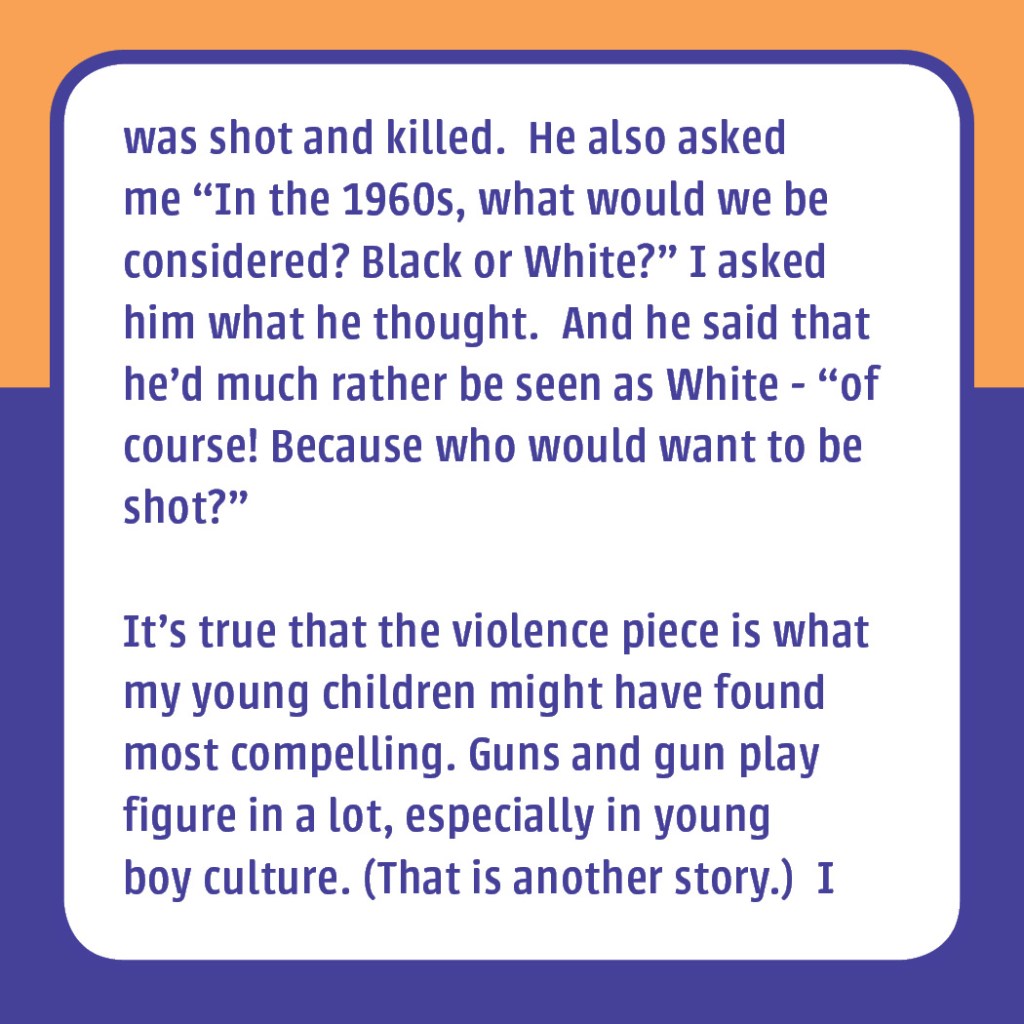
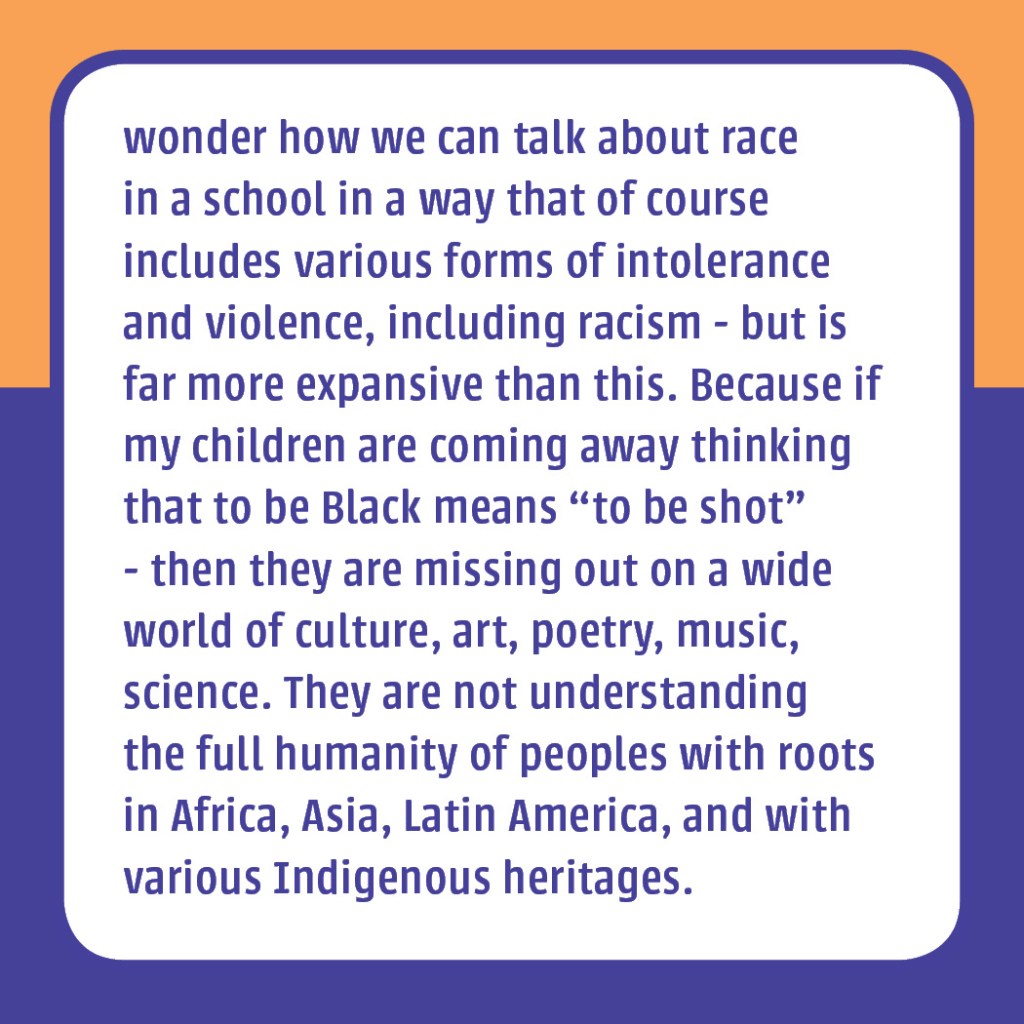
Image ID: the background of images 1-5 is orange (upper one-third) and purple (lower two-thirds), with a large white square with rounded corners overlaying and within that square, this text in purple: “I have two children in lower elementary school. I appreciate that Dr. Martin Luther King was discussed in January–this is more than what I got in elementary school. My children are mixed heritage–with one non-White parent and one White parent. After school, they were happy to chat with me about what they learned, without prompting from me. This isn’t always the case, and I was delighted by that. One of my children mentioned that they talked in school about how Dr. King was shot and killed. He also asked me, ‘In the 1960s, what would we be considered? Black or White?’ I asked him what he thought. And he said that he’d much rather be seen as White–’of course! Because who would want to be shot?’
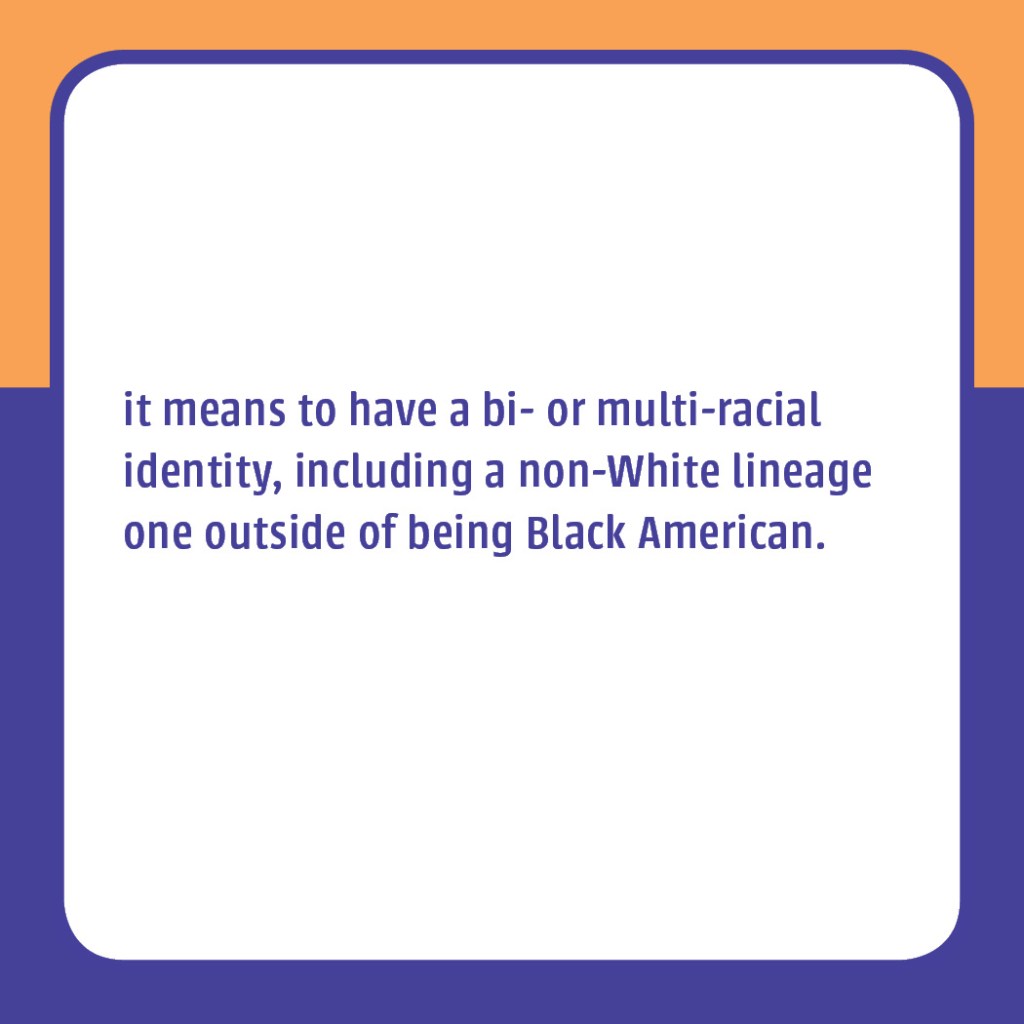
It’s true that the violence piece is what my young children might have found most compelling. Guns and gun play figure in a lot, especially in young boy culture. (That is another story.) I wonder how we can talk about race in a school in a way that of course includes various forms of intolerance and violence, including racism–but is far more expansive than this. Because if my children are coming away thinking that to be Black means ‘to be shot’–then they are missing out on a wide world of culture, art, poetry, music, science. They are not understanding the full humanity of peoples with roots in Africa, Asia, Latin America, and with various Indigenous heritages. And perhaps at school my children are missing out too on understanding a full picture of people with European heritages. Because all of these racialized identities are defined and constructed in relation to each other. That is, how can you understand what it means to be colonized without understanding colonizers and the social forces that compel any group of people to do what they do?
This doesn’t even begin to answer the question of what it means to have a bi- or multiracial identity, including a non-White lineage one outside of being Black American.”
Image 6 has the same orange/purple split background, with the white text “Story Themes” running up the lower left side and two columns of white boxes (four per column) displaying our eight story themes. Here, the themes Educational Challenges, Lack of Understanding, Emotional Response, Race & Identity, and The Future are emphasized with bright/bold colors.




 REAL
REAL 