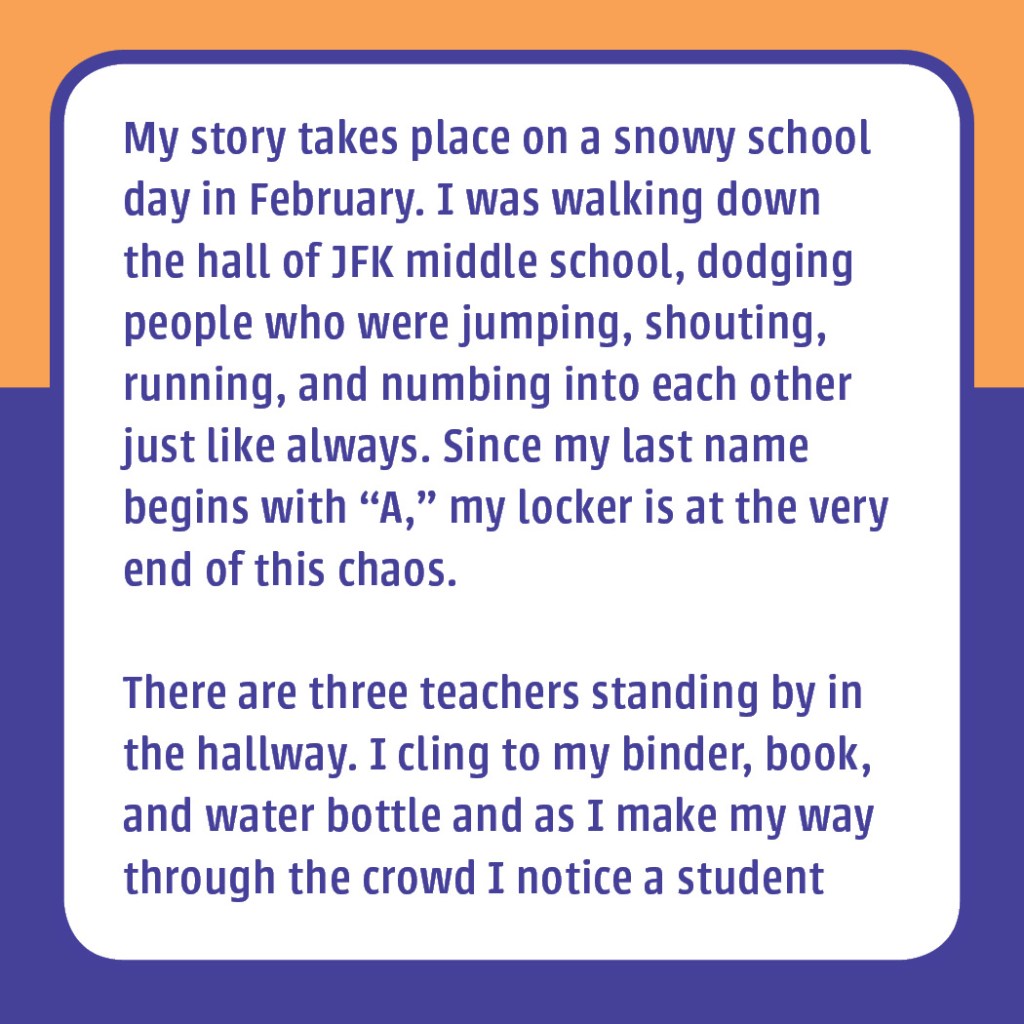
Image ID: the background of images 1, 2, and 3 is orange (upper one-third) and purple (lower two-thirds), with a large white square with rounded corners overlaying and within that square, this story in purple font: “My story takes place on a snowy school day in February. I was walking down the hall of JFK middle school, dodging people who were jumping, shouting, running, and numbing into each other just like always. Since my last name begins with ‘A,’ my locker is at the very end of this chaos. There are three teachers standing by in the hallway. I cling to my binder, book, and water bottle and as I make my way through the crowd I notice a student being pushed against a nearby locker by another. The second student is laughing as though this is all a hilarious joke. The first on the other hand, who is a person of color, looks downright terrified. I inch by, because I don’t like to be involved in sixth grade drama. But I should have done something, because this isn’t just drama–it’s bullying. I see the bully’s mouth moving, but I don’t hear what is coming out until he says the N word. At that the bully lets go and the kid takes a few steps back as the bully laughs. And the very worst part of all of this is that the kid forces a laugh too. Because the bully says that they are friends. But I know that it’s a lie–real friends don’t treat each other like this. And good teachers don’t allow things like this.”
Image 4 has the same orange/purple split background, with the white text “STORY THEMES” running up the lower left side and two columns of white boxes (four per column) displaying our eight story themes. Here, the themes “emotional response” and “hurt & exclusion” are emphasized with bright/bold colors and the themes “whiteness,” “the future,” “actions & strategies” “race & identity,” “lack of understanding,” and “educational challenges” deemphasized with paler colors.
Image ID: the background of images 1 and 2 is orange (upper one-third) and purple (lower two-thirds), with a large white square with rounded corners overlaying and within that square, this story in purple font: “In class we were watching a documentary about racial segregation and discussing it. One of my teachers (who was WHITE) said that she and her husband went to a movie and were the only white people there. She stated, ‘We knew what it felt like to be a minority.’ She can NOT say that! If she knew what some minorities have to face she wouldn’t have said that. No one in the class corrected her or mentioned it. I don’t even know if anyone else noticed. She probably didn’t realize, but that doesn’t even make it better. She could have been intentionally racist, however she wasn’t educated to know what she said was wrong. People need to understand and be educated on racism.”
Image 3 has the same orange/purple split background, with the white text “STORY THEMES” running up the lower left side and two columns of white boxes (four per column) displaying our eight story themes. Here, the themes “educational challenges” and “lack of understanding” are emphasized with bright/bold colors and the themes “whiteness,” “the future,” “actions & strategies” “race & identity,” “emotional response,” and “hurt & exclusion” deemphasized with paler colors.
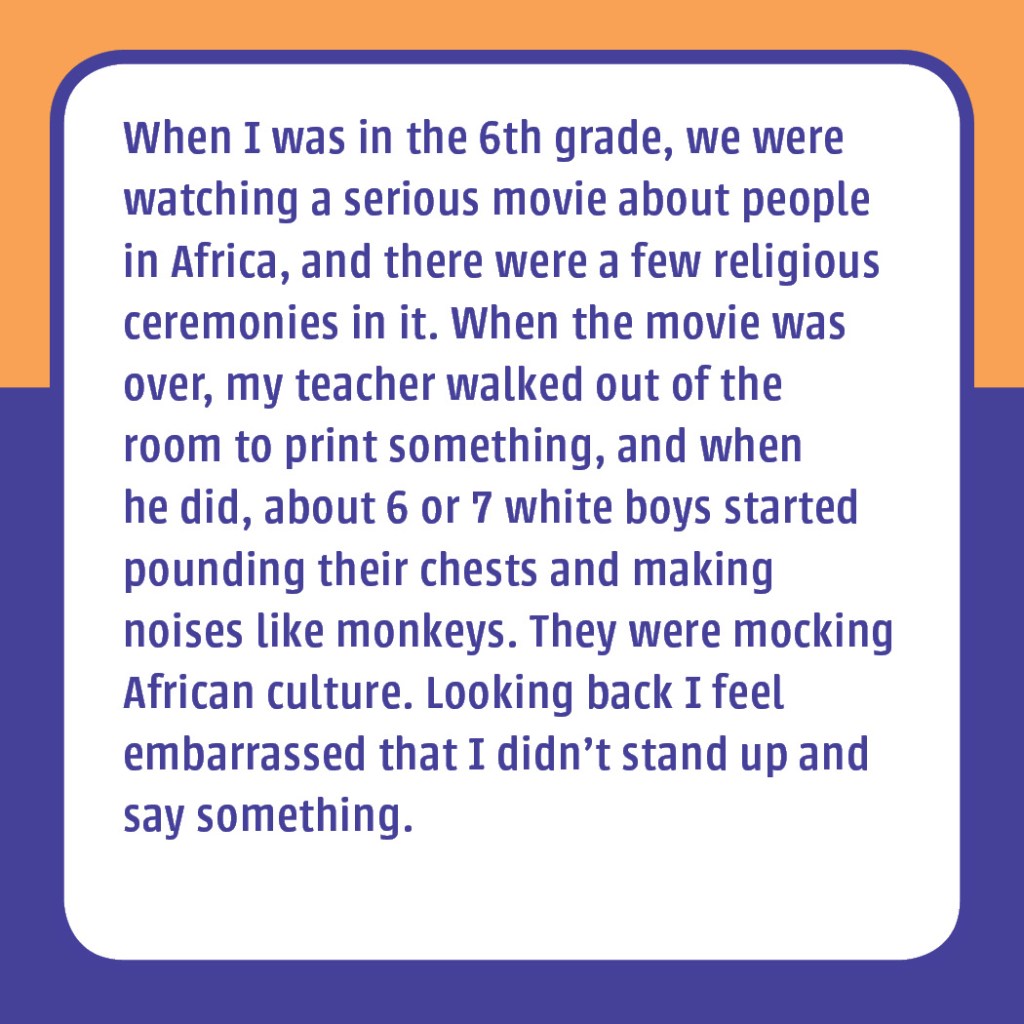
Image ID: the background of image 1 is orange (upper one-third) and purple (lower two-thirds), with a large white square with rounded corners overlaying and within that square, this story in purple font: “When I was in 6th grade we were watching a serious movie about people in Africa, and there were a few religious ceremonies in it. When the movie was over, my teacher walked out of the room to print something, and when he did, about 6 or 7 white boys started pounding their chests and making noises like monkeys. They were mocking African culture. Looking back I feel embarrassed that I didn’t stand up and say something.”
Image 2 has the same orange/purple split background, with the white text “STORY THEMES” running up the lower left side and two columns of white boxes (four per column) displaying our eight story themes. Here, the themes “lack of understanding,” “race & identity,” “emotional response,” “and hurt & exclusion” are emphasized with bright/bold colors and the themes “whiteness,” “educational challenges,” “the future,” and “actions & strategies” deemphasized with paler colors.



 REAL
REAL 