NHS conflicts & the need for restorative practices

[From an email sent March 16, 2022]

Dear School Committee Members and Superintendent Provost,

We, along with the broader community, have been watching recent exchanges at School Committee meetings about the shift to embedded honors in math courses at NHS. We have also read Susan Voss’s collection of Principal Vallaincourt’s correspondence–and we feel compelled to comment.

First, we want to clarify that, contrary to what’s in an email from Principal Vaillancourt on page 199 of Susan’s compilation, REAL never endorsed the shift to embedded honors in math at the high school.

Second, we want to express our disappointment at Principal Vallincourt’s urging of a colleague to “keep talking equity and they will be in our camp.” This use of “equity,” seemingly as a buzzword to persuade stakeholders of her position, devalues the actual work of equity and the many people across our district who are committed to it. And while we acknowledge there could be context around this quote that adds some nuance, the statement certainly doesn’t inspire confidence. Reasonable people can have different approaches to achieving district-wide equity, but all such approaches must involve respectful, inclusive, and transparent discussion.

We also read in the recent Gazette article that the move to embed honors in math has been in process since 2015, and yet it appears that the School Committee and caregivers only became aware of that change in 2021. Perhaps some of the tension and misunderstanding about the shift could have been alleviated with greater transparency and substantive engagement with all stakeholders over the years.

For REAL, the recent conflicts strongly underline the need for a deep investment of time and resources into restorative practices (RP) in the district. We believe that the RP approach to community building and conflict resolution is foundational to a school district that honors the dignity of all students and adults–and we can see how, in our current climate, taking a dedicated, well-funded restorative practices approach could give all parties a chance to be heard, accept accountability as appropriate, and move toward healing when people cause and experience harm.

As such, we fully support the RP funding that Superintendent Provost discussed in his recent budget proposal, to enable NPS stakeholders to develop a robust and sustainable plan for ongoing training and implementation of restorative practices across the district. And in the nearer term, one RP-aligned move that could be implemented by district leaders is to provide the NHS Student Union, and other students as applicable, with “restorative response” resources due to how they have been drawn into the conflict over embedded honors. It would likely be useful for these students to be part of a facilitated process during which they could debrief recent events and construct, together, a path forward. We would be happy to connect with you further on what this support might look like.

This is a tumultuous time in our world and district. We deeply appreciate all of your dedicated work in navigating with care, compassion, and inclusivity.

Sincerely,

The REAL Coordinating Team
Reflect, discuss

Prompts for personal reflection and conversation with others:

> What do you experience in your body (sensations), heart (feelings), and/or head (thoughts) on reading the stories we just posted?

> What do these stories make you want to do/say? What feels possible for you to do/say? What feels hard and/or hopeful?

> Who has the power in these stories? Whose voice/s are not being heard?

> What choices might the people in these stories have had–and/or not have had? What is the impact of the choices they make?

> What might they have said or done differently in the moment–or afterward–and what impact might it have had?

REAL Talk, story 24

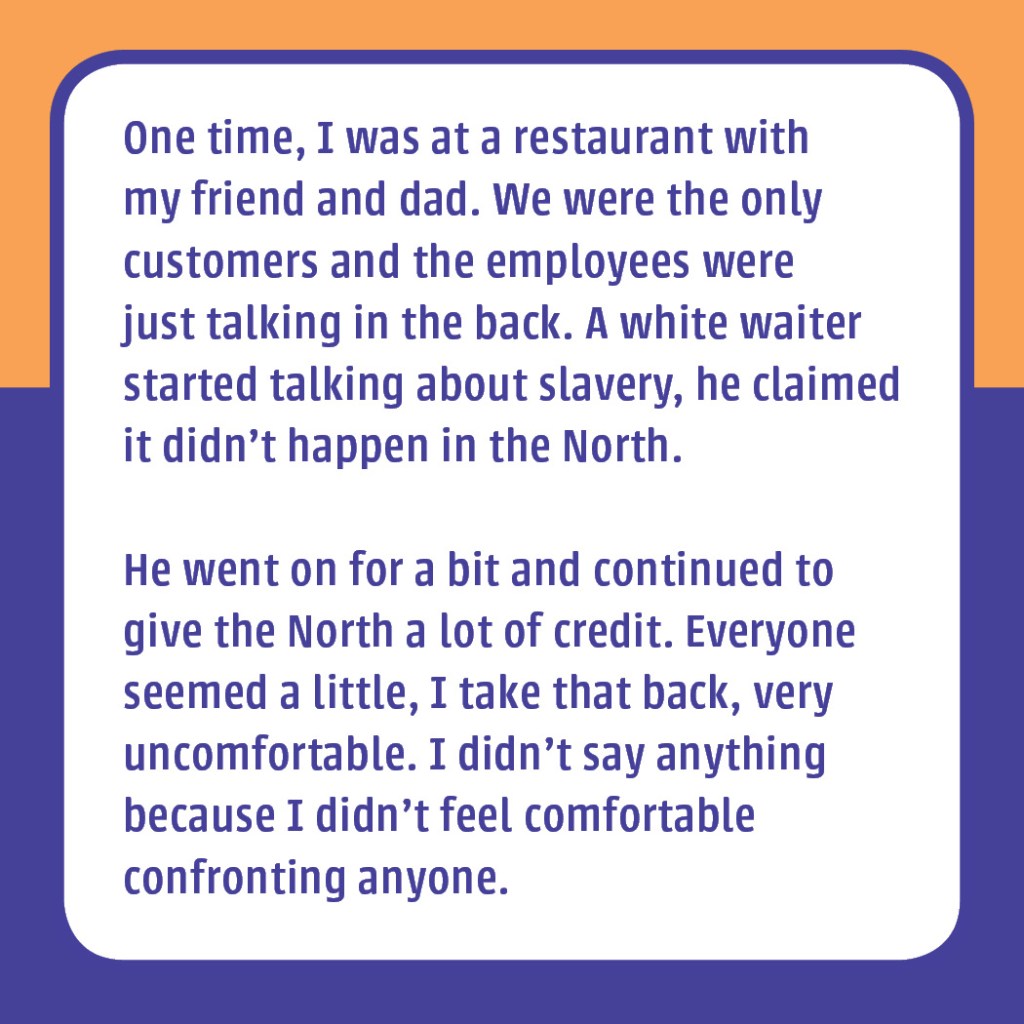
This story was shared by an NPS student.

Image ID: the background of image 1 is orange (upper one-third) and purple (lower two-thirds), with a large white square with rounded corners overlaying and within that square, this text in purple: “One time, I was at a restaurant with my friend and dad. We were the only customers and the employees were just talking in the back. A white waiter started talking about slavery; he claimed it didn’t happen in the North. He went on for a bit and continued to give the North a lot of credit. Everyone seemed a little, I take that back, very uncomfortable. I didn’t say anything because I didn’t feel comfortable confronting anyone.”

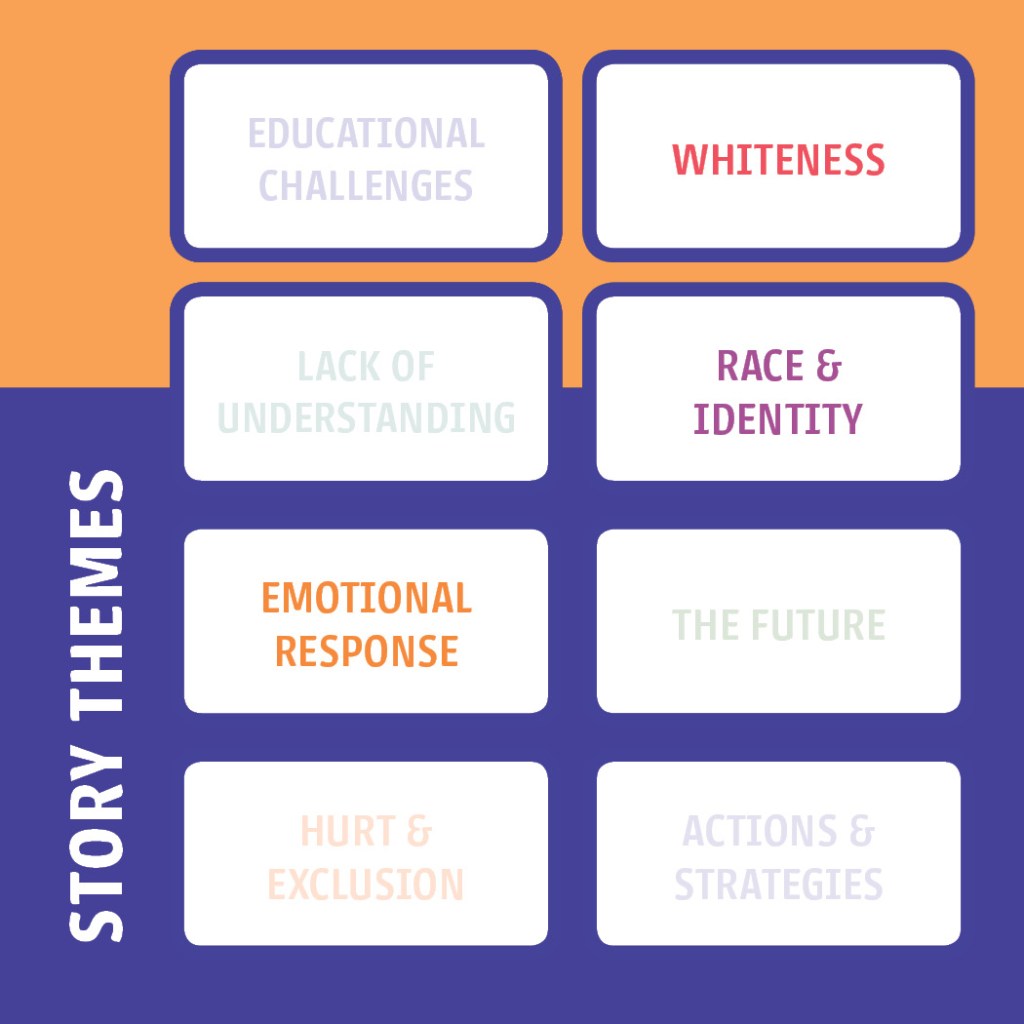
Image 2 has the same orange/purple split background, with the white text “Story Themes” running up the lower left side and two columns of white boxes (four per column) displaying our eight story themes. Here, the themes Emotional Response and Race & Identity are emphasized with bright/bold colors.

REAL Talk, story 23

This story was shared by an NPS parent/caregiver.

Image ID: the background of image 1 is orange (upper one-third) and purple (lower two-thirds), with a large white square with rounded corners overlaying and within that square, this text in purple: “I wish that languages besides English could be spoken freely in our schools without the speakers fearing embarrassment.”

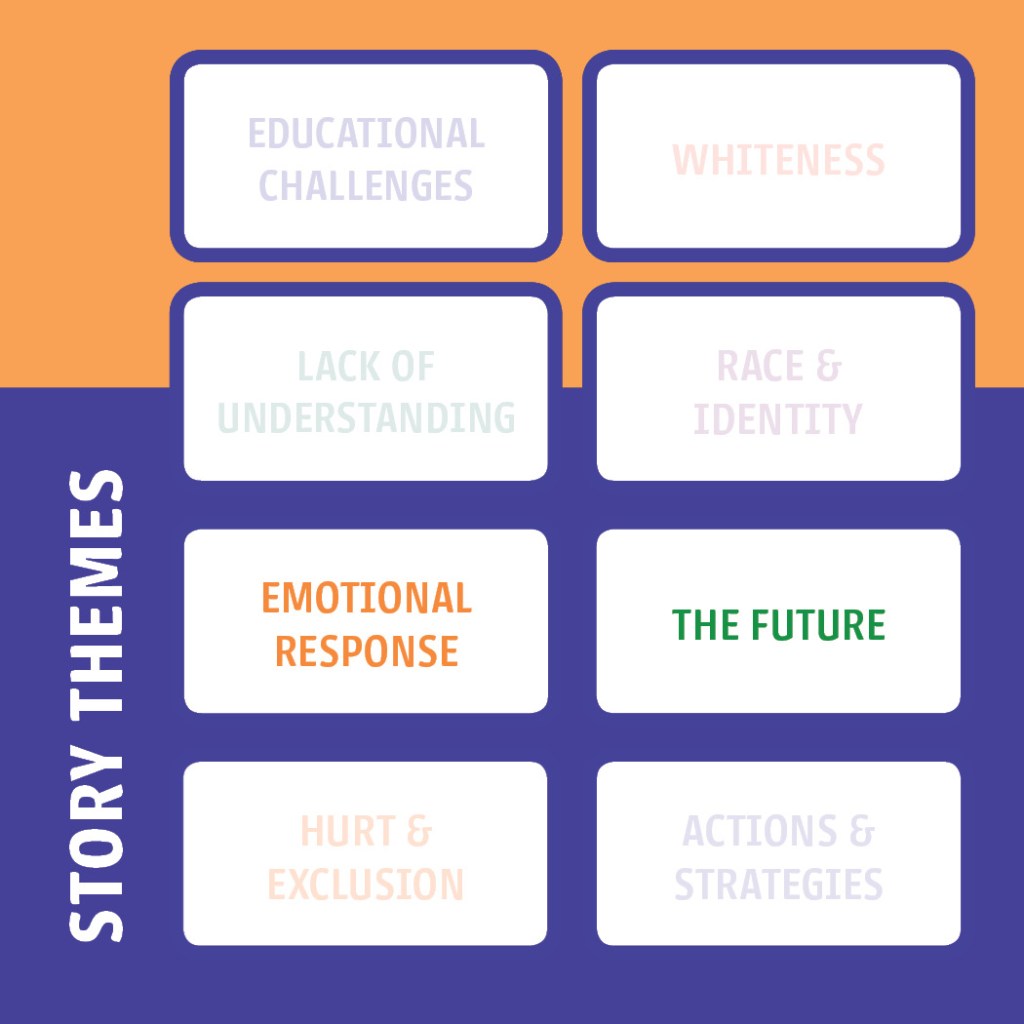
Image 2 has the same orange/purple split background, with the white text “Story Themes” running up the lower left side and two columns of white boxes (four per column) displaying our eight story themes. Here, the themes Emotional Response and The Future are emphasized with bright/bold colors.

REAL Talk, story 22

This story was shared by an NPS parent/caregiver.

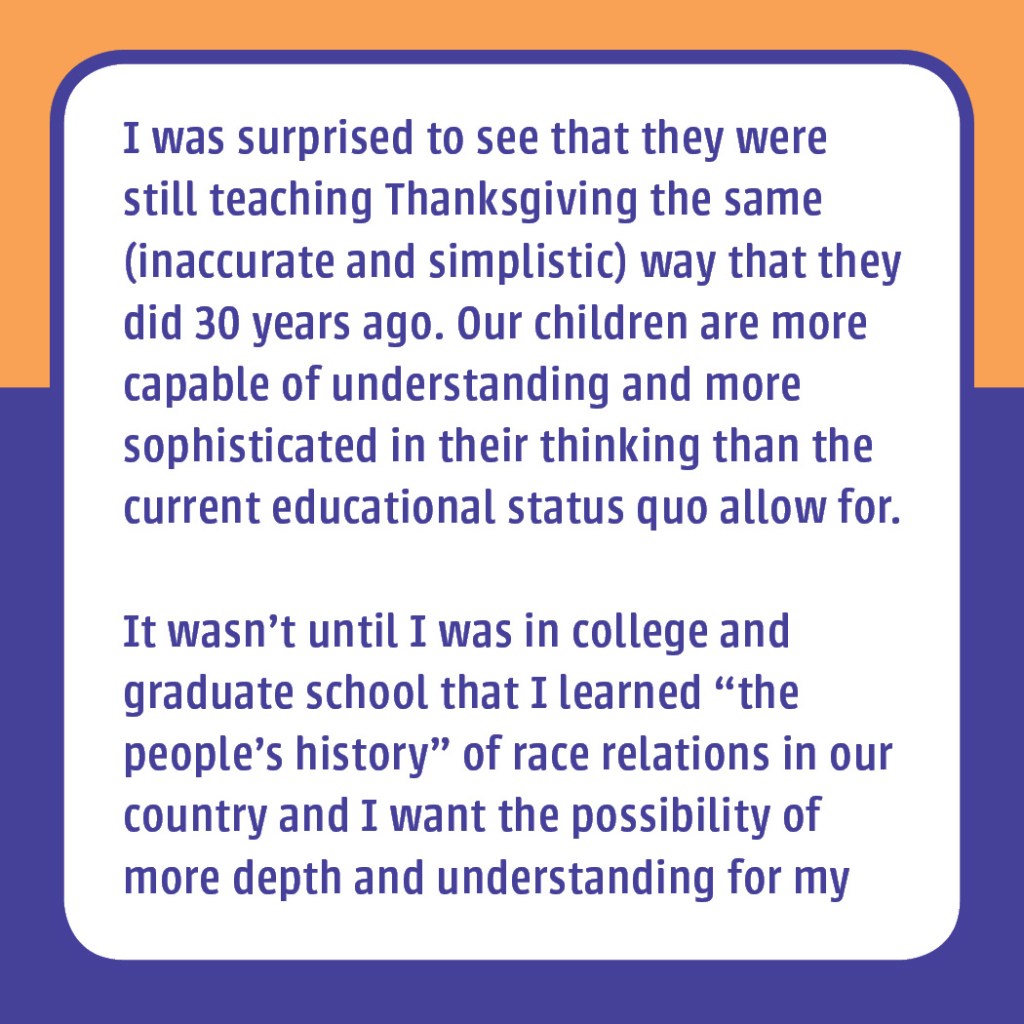
Image ID: the background of images 1 and 2 is orange (upper one-third) and purple (lower two-thirds), with a large white square with rounded corners overlaying and within that square, this text in purple: “I was surprised to see that they were still teaching Thanksgiving the same (inaccurate and simplistic) way that they did 30 years ago. Our children are more capable of understanding and more sophisticated in their thinking than the current educational status quo allows for. It wasn’t until I was in college and graduate school that I learned ‘the people’s history’ of race relations in our country, and I want the possibility of more depth and understanding for my children, for their generation, and for our country as a whole. It’s time we change the story(ies) to include more voices and more perspectives.”

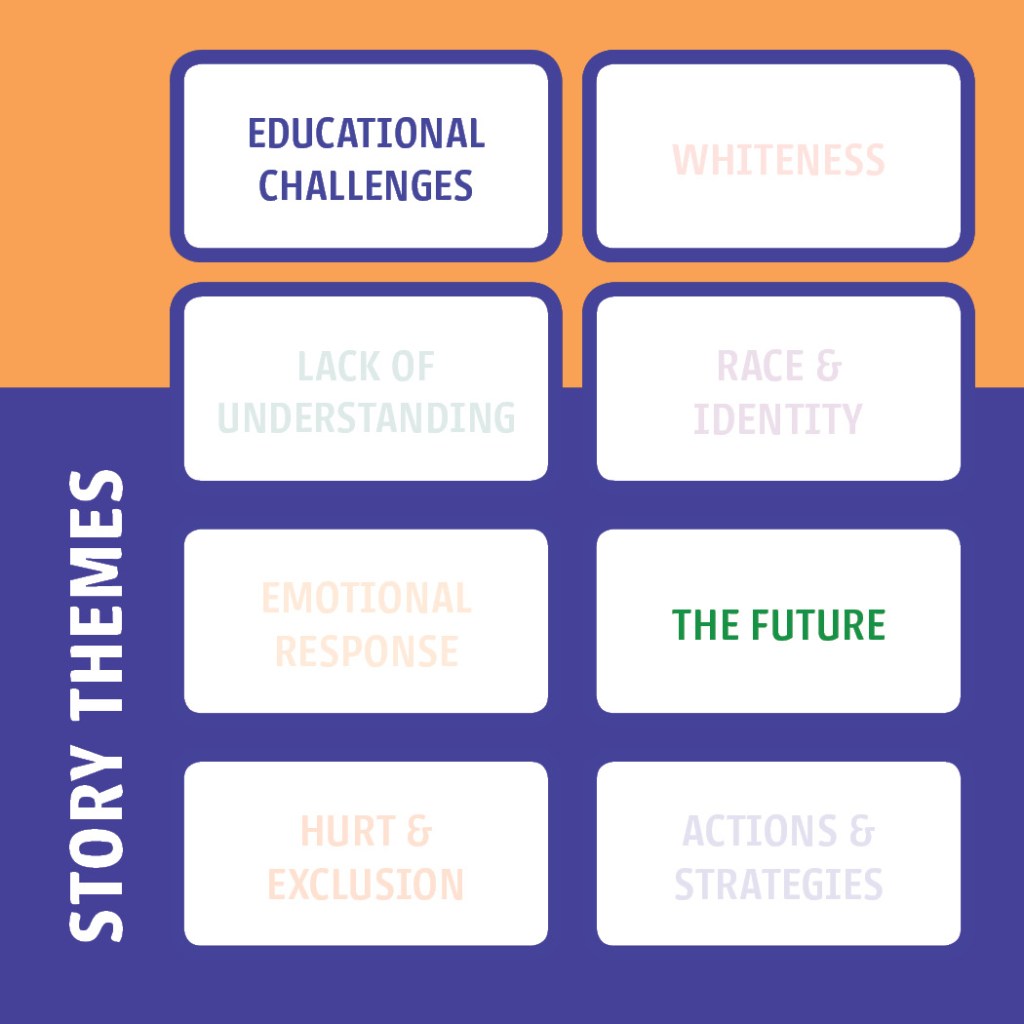
Image 3 has the same orange/purple split background, with the white text “Story Themes” running up the lower left side and two columns of white boxes (four per column) displaying our eight story themes. Here, the themes Educational Challenges and The Future are emphasized with bright/bold colors.